CONIC SECTIONS AND CIRCLES

DEGENERATE CONIC SECTIONS

HOW TO IDENTIFY THE FOUR CONIC SECTIONS IN EQUATION FORM
-
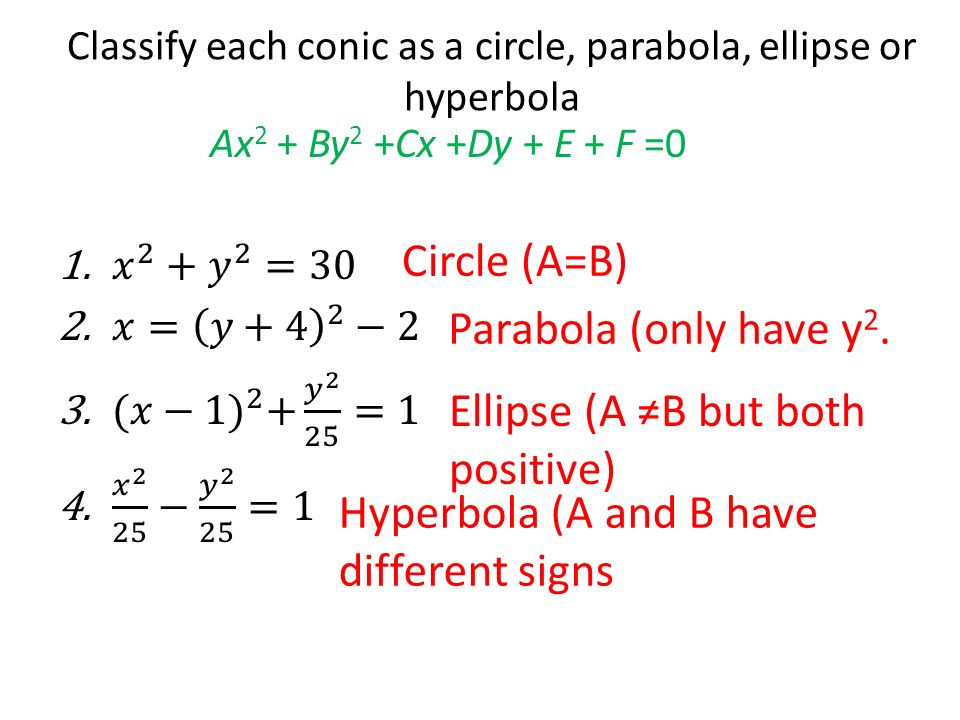
Circle. When x and y are both squared and the coefficients on them are the same — including the sign.
For example, take a look at 3x2 – 12x + 3y2 = 2. Notice that the x2 and y2 have the same coefficient (positive 3). That info is all you need to recognize that you’re working with a circle.
-
Parabola. When either x or y is squared — not both.
The equations y = x2 – 4 and x = 2y2 – 3y + 10 are both parabolas. In the first equation, you see an x2 but no y2, and in the second equation, you see a y2but no x2. Nothing else matters — signs and coefficients change the physical appearance of the parabola (which way it opens or how fat it is) but don’t change the fact that it’s a parabola.
-
Ellipse. When x and y are both squared and the coefficients are positive but different.
The equation 3x2 – 9x + 2y2 + 10y – 6 = 0 is one example of an ellipse. The coefficients of x2 and y2 are different, but both are positive.
-
Hyperbola. When x and y are both squared, and exactly one of the coefficients is negative and exactly one of the coefficients is positive.
The equation 4y2 – 10y – 3x2 = 12 is an example of a hyperbola. This time, the coefficients of x2 and y2 are different, but exactly one of them is negative and one is positive, which is a requirement for the equation to be the graph of a hyperbola.

CIRCLE
Formula of a Circle

STANDARD FORM TO GENERAL FORM

GENERAL FORM TO STANDARD FORM

EQUATION OF A CIRCLE THROUGH 3 POINTS
Example :
Find the center point and radius for the equation of a circle passing through (2,2), (2,4) and (5,5) x and y-coordinates.
Given :
A(2,2) B(2,4) C(5,5)
Solution :
Step :1
Substitute the given x and y-coordinates in the circle formula,
(2 – h)2 + (2 – k)2 = r2 ———— (1)
(2 – h)2 + (4 – k)2 = r2 ———— (2)
(5 – h)2 + (5 – k)2 = r2 ———— (3)
Step :2
Let us find the value of k by simplifying the first (1) and second (2) equation, (2 – h)2 + (2 – k)2 = (2 – h)2 + (4 – k)2 4 – 4h + h2+ 4 – 4k + k2 = 4 – 4h + h2+16 – 8k + k2 8 – 4k = 20 – 8k k=3
Step :3
Now, let us find out the value of h by simplifying the second (2) and third (3) equation (2 – h)2 + (2 – k)2 = (5 – h)2 + (5 – k)2 4 – 4h + h2+ 4 – 4k + k2 = 25 – 10h + h2+ 25 – 10k + k2 8 – 4k – 4h = 50 – 10h – 10k 6k + 6h = 42 Substitute k=3 in equation 6h = 24 h=4 Therefore center point is c(h,k) = c(4,3)
Step :4
Substitute h,k values in the given formula r2 = (x – h)2 + (y – k)2 r2 = (2 – 4)2 + (2 – 3)2 r2 = (-2)2 + (-1)2 r2 = 5 r = 2.24
Step :5
Substitute h, k values in the circle formula circle equation = (x – h)2 + (y – k)2 circle equation = (x – 4)2 + (y – 3)2
Result :
Center point is c(h,k) = c(4,3) Radius of a Circle r = 2.24 Circle Equation = (x – 4)2 + (y – 3)2 = (2.24)2
TANGENT TO A CIRCLE
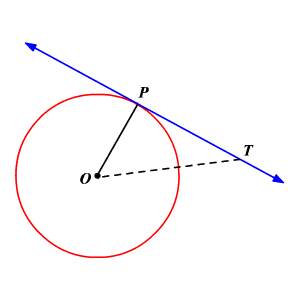
A tangent to a circle is a straight line which touches the circle at only one point. This point is called the point of tangency.
The tangent to a circle is perpendicular to the radius at the point of tangency.

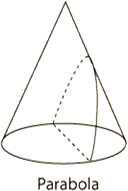
PARABOLA
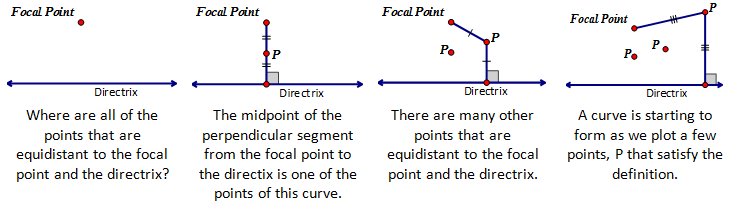
| CONCEPT 1 – The Definition of a Parabola
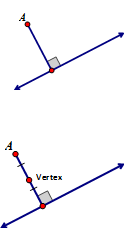
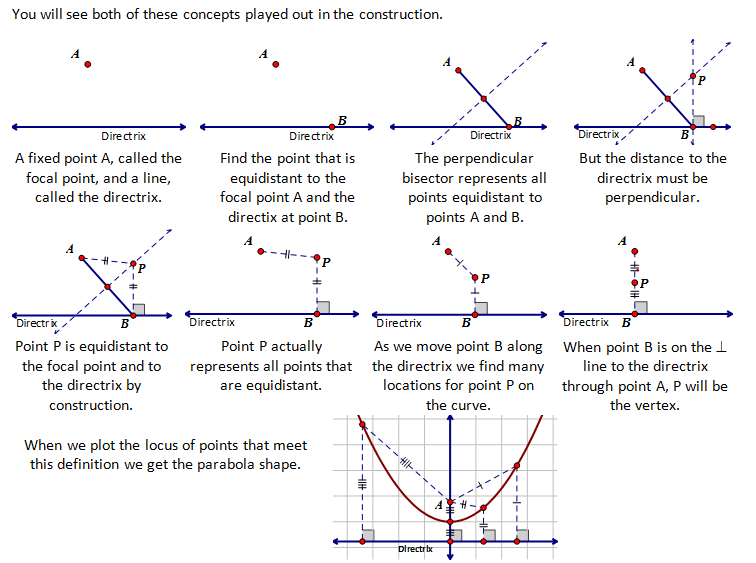
CONCEPT 2 – The Construction of a Parabola
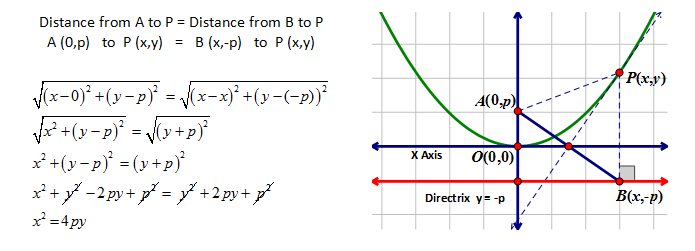
CONCEPT 3 – The Equation of a Parabola To arrive at the equation for the parabola we use its definition. To set this up we generate coordinates that represent these relationships. For simplicity we will use the origin (0,0) as the vertex. This creates a focal point that is directly above it, A(0,p) and a directrix that is the same distance from the vertex but in the opposite direction, y = -p. Traditionally the distance to the focal point from the vertex is labelled as p.
A couple of things to notice in our derivation of this equation:
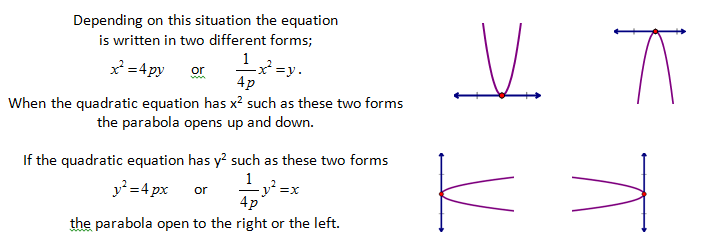
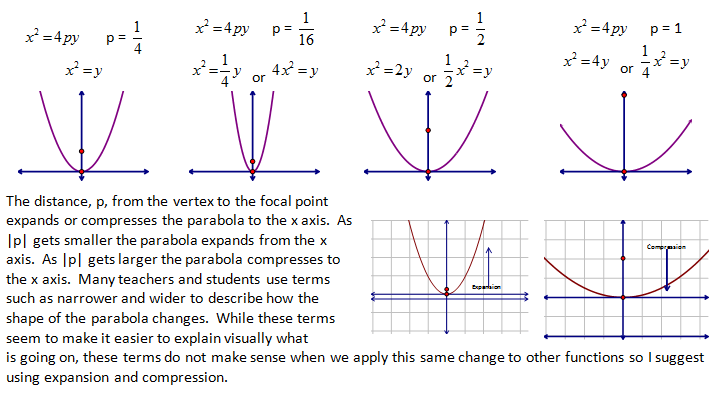
CONCEPT 4 – Understanding the Equation of a Parabola
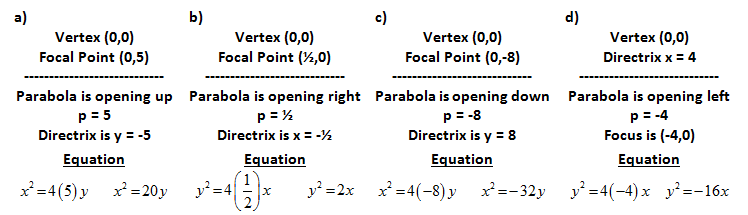
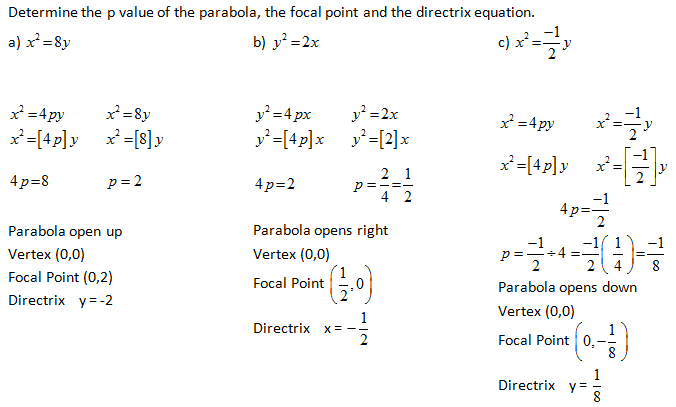
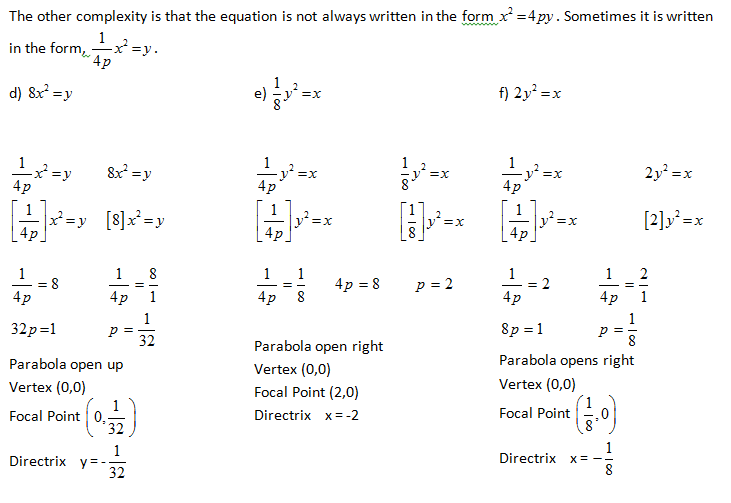
Understanding the forms of the equation and how the focal point, vertex and directrix relate to each other allows us to determine information from each other. The following examples display this connectivity.
The vertex and the p value allow us to determine anything we want to know about the parabola.
|


 Reuben's Blog